Progress is Powered by People: Reflecting on Growth, Change and Impact in 2026
Categories : Blog
Posted:
Author: Digital Frontiers Institute
When I reflect on 2026, the people behind our progress stand out most. Across Digital Frontiers Institute, technical experts shared their knowledge, learning facilitators supported participants, colleagues worked behind the scenes to deliver learning experiences and professionals connected across borders to learn from one another. Every milestone depended on people sharing their expertise, working together and creating opportunities for others to grow.
Together, we navigated a year of rapid technological change, evolving development priorities and growing demand for digital skills. For Digital Frontiers Institute, it was a year of growth, innovation and new opportunities to support professionals navigating an increasingly complex landscape. But growth is not simply about doing more. For us, it is about reaching more people, responding to their needs and helping them build the knowledge, confidence and connections to make a difference in their organisations and communities.
One example is Digital Public Infrastructure (DPI) Essentials: The Identity Layer, which helps practitioners deepen their understanding of digital identity systems and their role within broader digital public infrastructure ecosystems. As countries explore ways to build secure, inclusive and accessible digital services, developing this knowledge is increasingly important.
We also responded to the needs of specific institutions and sectors through tailored learning initiatives. Through customised DPI workshops and exchanges, including our Namibia DPI Exchange, participants explored how digital public infrastructure can strengthen public services, advance financial inclusion and address practical challenges within their own contexts. By connecting international expertise with local priorities, these engagements created opportunities for meaningful dialogue and practical application.
Our partnerships have also enabled us to extend our work into new sectors. Through the Animation Studio Accelerator Programme, supported by the Government of Japan and delivered by Digital Frontiers in partnership with the Triggerfish Foundation on behalf of the UNDP timbuktoo Creatives Hub in Cape Town, we support animation studios in Africa to strengthen their businesses, build industry connections, and pursue opportunities for sustainable growth.
We have also expanded our learning platform’s reach through partnerships. With one partner, we developed seven courses delivered through a white-label version of our learning platform, reaching more than 400 participants during the year. This demonstrates how we can combine digital learning capabilities with sector expertise to extend access to specialised knowledge.
We also continued to explore opportunities to apply our digital learning expertise across new sectors, including disaster preparedness. Through this work, we are exploring how digital learning can make relevant knowledge and practical resources more accessible to professionals in different contexts.
While these initiatives address different needs, they share a common purpose: helping people and organisations develop the capabilities to respond to change. They also demonstrate the value of collaboration, bringing together different strengths, expertise and experiences to create opportunities that would be difficult to achieve in isolation.
This spirit of collaboration is particularly visible within our CoPs and through the Risk-Based Supervision Global Exchange. Throughout the year, professionals from different markets came together to discuss shared challenges, exchange experiences, and strengthen supervisory capabilities. Discussions explored topics including data quality, SupTech, virtual assets and emerging regulatory risks, providing participants with practical insights that could be applied in their own supervisory environments.
Beyond formal programmes, our online networking forums, including our Masterclasses, Digital Finance Dialogues, and our online global CoP, continue to foster global knowledge sharing among our community of digital finance professionals. Our League of Digital Finance Professionals is a LinkedIn group and global online community of practice that connects more than 9400 practitioners and supports learning across the digital financial services ecosystem.
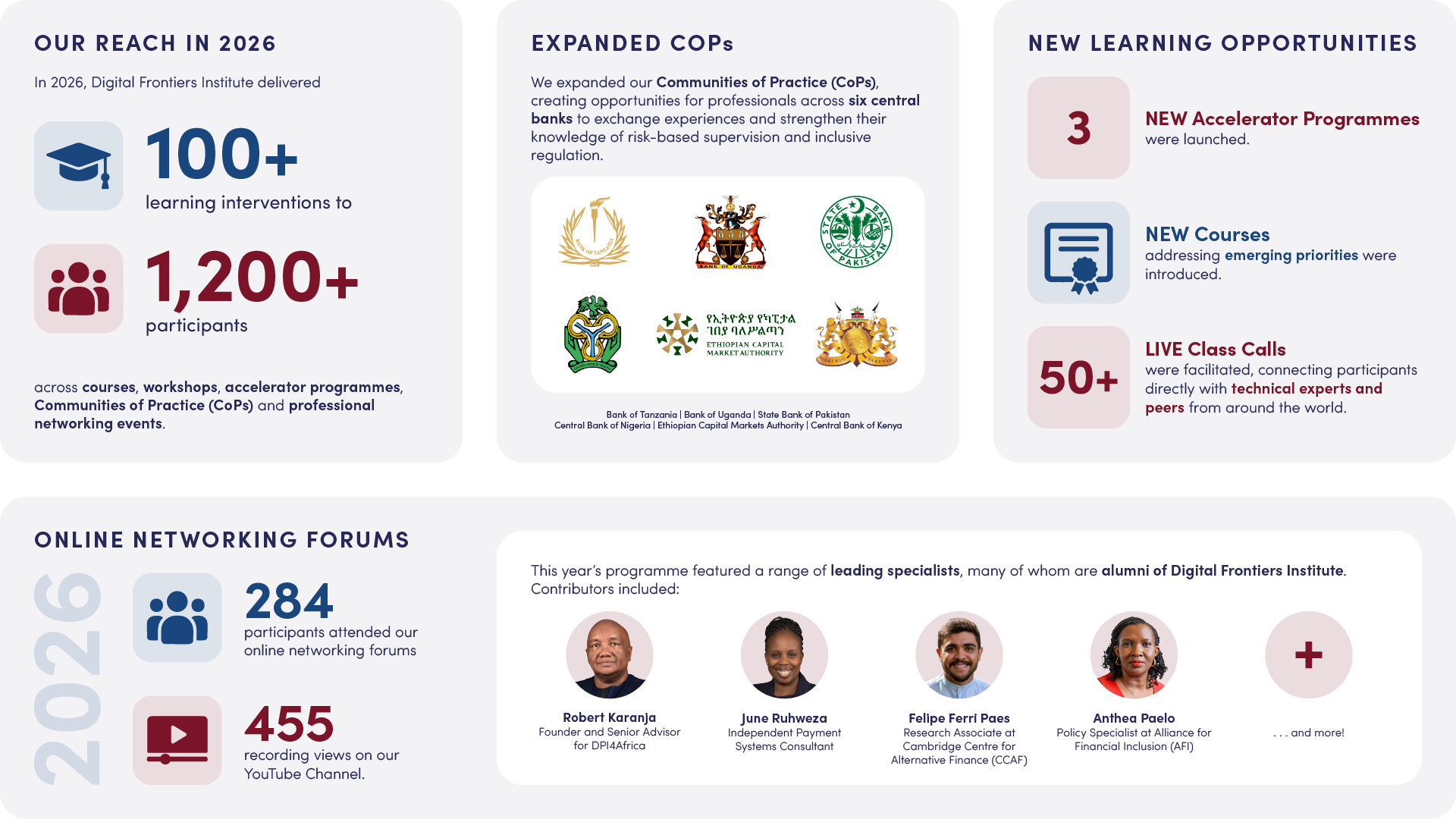
This year, 284 participants attended our online networking forums, with recordings subsequently viewed 455 times on our YouTube channel. This year’s programme featured a range of leading specialists, many of whom are alumni of Digital Frontiers Institute. Contributors included Robert Karanja, Founder and Senior Advisor for DPI4Africa; June Ruhweza, Independent Payment Systems Consultant; Felipe Ferri Paes, Research Associate at Cambridge Centre for Alternative Finance (CCAF); and Anthea Paelo, Policy Specialist at Alliance for Financial Inclusion (AFI), alongside other specialists. These experts shared their expertise across DPI, stablecoins and tokenisation, fair competition, regulatory barriers for electronic money institutions and MSME access to digital finance and more. These expert contributions enriched the exchange of practical knowledge.
These conversations create opportunities for learning that extend beyond formal training. Professionals benefit not only from technical experts and course materials but also from colleagues who have faced similar challenges, tested different approaches and developed practical solutions. By creating opportunities for peer exchange across institutions and countries, we help participants connect what they learn to their own experiences and draw on a broader range of perspectives.
We were also delighted to have “What Happens When Risk-Based Supervision Moves from Theory to Practice” chosen as one of the on-demand sessions at this year’s Financial Inclusion Week, held virtually to a global audience of inclusive finance professionals. Our session drew on the experience of supervisors who have participated in our Risk-Based Supervision for Inclusive Digital Financial Services programme to examine how risk-based and proportionate approaches are being applied in practice. Speakers discussed how leadership support and CoPs can help supervisors apply new approaches and sustain change.
Ultimately, this is where learning moves beyond our digital learning platform and into everyday practice. Participants test ideas, adapt approaches and discover where they need further support. Alumni networks, expert communities, and ongoing professional relationships sustain this process, giving people opportunities to ask questions, share resources, and keep learning together.
Our alumni share:
“The practical and interactive nature of the programme worked particularly well for me. The use of real-world examples, case studies, practical exercises, and peer discussions helped me connect the concepts to my day-to-day supervisory responsibilities. I also found the opportunity to learn from colleagues and share experiences particularly valuable, as it provided different perspectives on how risk-based and proportional supervision can be applied in practice.”
“Enrolling in Digital Frontiers Institute’s courses has been one of the most impactful decisions of my career. From the Full Gender Equality Changemakers Programme to the Certificate in Digital Money and specialised courses on Instant Payments and Digital Financial Inclusion Supervision, each programme has significantly deepened my understanding of financial systems, innovation, and inclusion. The practical and insightful curriculum, coupled with expert facilitators and a dynamic peer-learning environment, made the experience both enriching and empowering. I particularly appreciated the real-world application of concepts, which has directly enhanced my ability to drive meaningful change in the financial sector.”
“As a Business Development Manager, my experience at the Digital Frontiers Institute has been transformative. The exceptional learning environment and the cutting-edge curriculum provided me with the knowledge and skills necessary to excel in the rapidly evolving field of digital finance. Through the immersive programmes, I gained deep insights into innovative business strategies and emerging technologies, which directly enhanced my ability to identify new market opportunities for my company. The alumni community has also been instrumental in expanding my professional network, enabling collaborations that have significantly contributed to our growth.”
Behind these learning experiences are the people who make them possible. Technical experts contribute insights shaped by years of professional practice. Learning facilitators guide discussions, encourage participation and help participants engage with challenging concepts. Participants bring their own experiences, questions and perspectives, enriching the learning for everyone involved. Knowledge moves in both directions: from experts to participants, between peers and back into the organisations and communities where people work.
Our Learning Solutions, Programmes and Delivery teams bring these elements together. They coordinate course development, facilitation, participant support and operational delivery, connecting the expertise and resources that effective learning requires. Their work often happens behind the scenes, but it enables participants to engage meaningfully, contribute their own knowledge and build relationships that last beyond a programme.
As our learning portfolio has grown, we have also explored how technology can help us support participants and teams more effectively. This year, we introduced Fronti, an AI-powered (artificial intelligence) learning support assistant on the Digital Frontiers Learning Platform. Fronti helps participants navigate the learning platform, locate resources and find answers to common technical questions, making it easier for them to access support as they engage with online learning. We also explored how AI could support learning design, content development and internal processes. These initiatives helped us identify opportunities to improve efficiency, streamline tasks and give our teams additional ways to support the participant experience.
We also piloted an AI-enabled multilingual delivery model. The initiative explored how technology could help make learning more accessible across different linguistic contexts, reducing language barriers that may prevent professionals from accessing relevant training and development opportunities. While the pilot remains an area of ongoing exploration, it reflects our commitment to finding practical ways to extend the reach and accessibility of our programmes.
However, adopting new technology is not simply about doing things faster. We must also consider how we protect quality, maintain accuracy and ensure that innovation serves the people who use our programmes. Our approach centres on using AI purposefully and responsibly, with appropriate human oversight. Technology can help us locate information, improve processes and support content development, but technical experts, learning facilitators and programme teams bring the professional judgement, contextual understanding and human connection that remain essential to effective learning.
We have also strengthened how we connect with participants throughout their learning journeys. This year, we formally introduced a WhatsApp channel to share updates, news and learning opportunities with our broader audience. Our delivery team also uses WhatsApp Business to guide participants through enrolment and their courses, while learning facilitators communicate through course-specific WhatsApp groups to share important announcements and reminders. These channels complement our digital learning platform and help ensure participants feel supported and connected throughout their experience.
While 2026 brought growth, new opportunities and important milestones, it was also a year of profound loss.
This year we said goodbye to our colleague, Cedric Moubitang, who spent more than four years supporting participants across the Digital Frontiers community as a valued member of our Learning Facilitation team and the wider Francophone community. Cedric’s warmth, generosity and commitment to others left a lasting impression on colleagues and participants alike. His contribution extended beyond the programmes he facilitated, through the relationships he built and the support he gave so freely. His passing was deeply felt across our community. We are reminded that the impact of our work is measured not only in programmes delivered and participants reached, but also in the relationships we build and the difference we make in people’s lives. Cedric will remain an important part of the Digital Frontiers story.
As we look towards 2027, the landscape will continue to evolve. AI will create new possibilities and challenges, digital public infrastructure will remain an important area of development, and organisations across sectors will need to adapt to changing technologies, regulations and market demands. We will continue to grow our learning portfolio, strengthen partnerships and explore new ways to support professionals and institutions navigating these changes. We will seek opportunities to reach new communities, deepen existing relationships and use technology to improve how we develop and deliver learning. Just as importantly, we will continue listening to participants, understanding the challenges they face and ensuring our programmes remain relevant to their needs.
Responding to these challenges will require technical expertise and innovation, but it will also require collaboration, trusted partnerships and communities where people can share knowledge and learn from one another. Our ability to bring these elements together will shape how effectively we respond to change and where we can make the greatest contribution.
As 2026 draws to a close, we thank every participant, alumnus, technical expert, learning facilitator, colleague and partner who has contributed to this journey. Your expertise, curiosity, generosity and commitment have helped us grow, adapt and create opportunities for others.
Ultimately, people drive progress: people who share their knowledge, support each other, and turn learning into action. They are the reason we do this work, the force behind what we achieve and the foundation on which we will build what comes next.
Progress is powered by people.
By Camilla Ferguson
Senior Manager of Strategy, Operations and Organisational Effectiveness at Digital Frontiers
Digital Frontiers Institute Alum
(Article also shared on Digital Frontiers on 19 November 2026)