How Artificial Intelligence Powers Learning and Impact at Digital Frontiers
Categories : Blog
Posted:
Author: Digital Frontiers Institute
Artificial intelligence (AI) is transforming the way organisations learn, collaborate, and solve complex challenges. Across governments, financial institutions, development organisations and the private sector, AI has the potential to create new opportunities to improve efficiency, enhance decision-making, and expand access to knowledge. With the rise of generative AI powerhouses such as ChatGPT, Claude and Microsoft Copilot, and with AI integrations into Canva, Google, Grammarly, and other tools, the need to implement and collaborate with AI tools in the workplace has become undeniable.
At Digital Frontiers, we see responsible AI as a powerful enabler of our mission: to strengthen people and institutions to drive inclusive development in the digital economy, enabling lasting, scalable, and locally grounded change. Our approach is guided by a simple principle: AI should strengthen human capability, not replace it.
We are committed to using AI in ways that prioritise ethics, transparency, and accountability. This includes maintaining human oversight, protecting data privacy, respecting intellectual property, and ensuring that AI-supported outputs are carefully reviewed before they become part of our learning experiences or organisational processes.
Responsible AI requires more than adopting new tools. It requires strong governance, thoughtful implementation, and a commitment to ensuring technology contributes to inclusive and sustainable development. As countries accelerate their digital transformation journeys, the need for skilled professionals and resilient institutions has never been greater. Building inclusive digital economies requires more than technology; it requires people with the knowledge, skills and confidence to design, govern and implement digital systems that work for everyone.
Putting People Before Technology
Technology alone does not drive development. People and institutions do. Digital transformation succeeds when practitioners have the knowledge to design inclusive systems, regulators have the confidence to develop enabling policy, and institutions have the capability to implement change that is sustainable and locally relevant.
That belief shapes our approach to AI. Across Digital Frontiers, AI supports our teams by reducing repetitive tasks, streamlining workflows, and accelerating knowledge creation. This enables our learning designers, technical experts, and programme teams to dedicate more time to what matters most: collaboration, innovation, problem-solving and supporting the organisations we work alongside. AI can be a tool that strengthens our capabilities. Human experience, contextual understanding, and professional judgement remain at the centre of our work.
Enhancing Digital Learning Production
We started using AI-integrated tools in 2023, which has helped us improve the flexibility and accessibility of our digital learning solutions. One of the earliest applications of AI within our digital learning solutions work was through AI-generated voiceovers. Advances in voice models, pronunciation refinement, and customisation have enabled us to create increasingly natural voiceovers that support engaging learning experiences, adapt pronunciation, and make updates quickly when content changes.
More recently, we have integrated AI tools into our video production workflows to support the development of digital learning content. These tools can assist with transforming storyboards and scripts into initial video drafts, including pacing, transitions, and structure. The outputs are then reviewed and refined by our digital learning specialists and video team, who apply their expertise to ensure the final product meets our quality standards.
This approach has significantly improved efficiency, reducing some processes from several days to only a few hours, and allows us to deliver high-quality learning solutions while optimising resources. This enables us to respond more quickly to partner needs while maintaining the quality and participant experience expected from Digital Frontiers.
Supporting Course Design and Content Development
AI is also supporting our instructional design processes. Our learning designers use AI to assist with curriculum planning, content development, and assessment creation. However, effective AI integration requires more than simply using a tool; it requires expertise, careful guidance, and strong instructional design principles.
Our teams have developed structured approaches for working with AI, including providing relevant reference materials, learning frameworks, adult learning principles, course standards, and specific project requirements. This enables AI tools to support our design process while ensuring outputs remain aligned with our quality standards.
Improving the Participant Experience
AI is also helping us make learning more accessible and responsive for our participants. Through our website and Digital Learning Platform, we are exploring ways AI can improve how participants interact with Digital Frontiers and access the knowledge they need.
We’re excited to introduce Fronti (/ˈfrɒn-ti/, pronounced “FRON-tee”), our new AI-powered assistant on the Digital Frontiers Learning Platform. Fronti provides participants with instant, on-demand support throughout their learning journey. It helps users navigate the platform, answer common questions and troubleshoot technical issues quickly, so they can spend less time waiting for support and more time focused on learning.
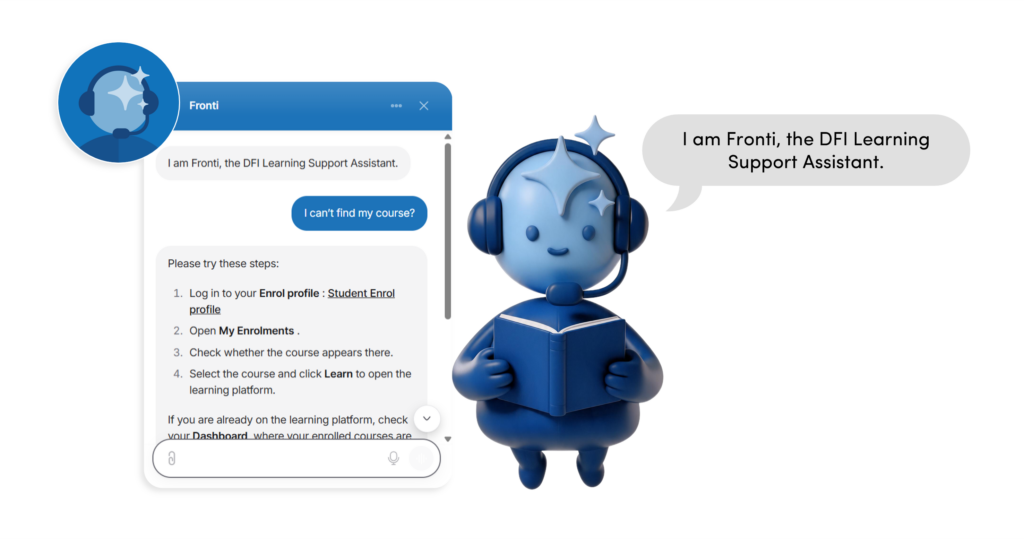
However, human interaction remains central to the learning experience; our learning facilitators and technical experts continue to provide the mentorship, discussion, and contextual insight that no technology can replace, and our admissions and customer support teams are now available on WhatsApp and email via info@digitalfrontiers.org during weekday work hours.
Supporting Expert Knowledge with Responsible AI
The strength of every Digital Frontiers learning experience lies in the expertise of the practitioners who create it. Our technical experts bring decades of experience from central banks, regulators, financial institutions, development organisations, and the broader digital economy. Their real-world knowledge ensures that every learning experience is practical and grounded in implementation. For additional quality assurance of assessments, we use AI as a second set of eyes during the grading moderation process to identify inconsistencies and support greater consistency. However, final academic decisions are always made by our learning facilitators and technical experts.
We encourage our technical experts to use AI responsibly throughout the content development process. AI can help organise ideas, improve clarity, support research, and enhance the overall quality of written material.
However, expertise must always come from the expert. While we encourage the responsible use of AI as a productivity tool, we try not to publish educational content that exceeds our AI authorship threshold of 30%. Every AI-generated output is reviewed, refined, and contextualised by our team. We use AI to enhance human expertise, not replace it, ensuring our work remains relevant, accurate, and participant-focused; this way, human expertise remains central. This approach ensures that every blog reflects authentic practitioner experience, original insight and contextual understanding while benefiting from the efficiencies that responsible AI can provide.
Communicating Knowledge More Effectively
Sharing knowledge is central to our mission, and while we prioritise and value human creativity in design, communications, storytelling and marketing, there are ways we can strategically leverage artificial intelligence to enhance ideas, optimise workflow and streamline productivity (IENYC.EDU, 2025). Whether we are publishing thought leadership, promoting learning opportunities or engaging with partners around the world, our communications are designed to make complex topics more accessible and actionable.
However, according to IENYC, human-centred marketing will always be our aim, as it is driven by three things that AI cannot replicate: empathy (understanding emotion and human behaviour), imagination (bold creative leaps) and ethics (knowing when not to act, even when the technology says you can).
That is why our marketing and communications teams use AI to support research, content planning, and audience analysis. AI also assists with repurposing content and analysing engagement, which enables our team to spend more time crafting meaningful stories and demonstrating the impact of our work. Every piece of content is reviewed and refined by our creative team to ensure it reflects the quality and credibility that Digital Frontiers is known for while maintaining our brand voice.
Becoming a More Insight-Driven Organisation
Continuous learning applies not only to our participants but also to ourselves. We use AI to assist us with strategic problem-solving to challenge assumptions, identify gaps, explore alternative approaches and strengthen decision-making across the Learning Experiences team. Other ways we use AI tools are for participant insights and continuous improvement. AI helps us gather participant insights by identifying recurring participant questions, support trends and friction points so we can proactively improve communications, platform guidance and course design. We then combine participant feedback, engagement data and AI-assisted analysis to identify trends, uncover insights, and continuously improve our courses, learning journeys and overall participant experience.
Looking Ahead
The future of education, the workforce and development will continue to be shaped by artificial intelligence, and rather than redefining our objective, we see this as a chance to improve on it. By fusing human expertise with responsible AI, we are increasing accessibility to information, improving institutional capacity and developing educational opportunities that enable individuals to spearhead inclusive digital transformation inside their own nations and communities.
The future of the digital economy will be built not by technology alone, but by capable people, resilient institutions, and strong partnerships. Digital Frontiers is dedicated to creating that future.
By Dané Brown (Marketing Operations Manager), Bryanah Kirsten Marais (Content and Communications Specialist), Mel Houseman (Creative Lead), and Camilla Ferguson (Senior Manager of People Operations and Strategy)
(Article originally shared on Digital Frontiers on 11 September 2026)