To Lend or Not to Lend? An Analysis of Alternative Data for Smallholder Credit Scoring
Categories : Blog
Posted:
Author: Digital Frontiers Institute
Imagine sitting across from a smallholder farmer who needs a loan to buy seeds and fertiliser. She has no land title to offer as collateral, no formal financial history, and yet, her livelihood and that of her community depend on that next planting season. For traditional lenders, she represents an unbankable risk. However, for forward-thinking institutions, she represents part of a $ 200 billion credit gap for smallholders, an opportunity waiting to be unlocked. This dilemma plays out millions of times across developing economies. The issue isn’t a lack of initiative or productivity; it’s the absence of traditional collateral. But what if we could reimagine creditworthiness? What if, instead of assets, we looked at behaviour, transactions, and potential?
This was the core of a recent assignment in my Digitising Agriculture course at Digital Frontiers Institute. Playing the role of an underwriting officer, I evaluated a partnership with DigiAgri, a digital farm management platform, to assess four alternative data points for collateral-free lending.
This isn’t a theoretical exercise. It’s a practical blueprint for closing the finance gap. Here is my analysis of what truly signals creditworthiness in the world of smallholder agriculture.
Here is my analysis of what signals true creditworthiness and what merely signals potential.
The Analytical Framework: Capacity, Character, and Conditions
To evaluate these data points, I used a tripartite framework, assessing how well each one predicts:
- Capacity: The demonstrable ability to repay a loan from future cash flows.
- Character: The proven willingness to repay, reflecting integrity and financial discipline.
- Conditions: The external, environmental factors that could impact the borrower’s success.

The Data Points: A Detailed Verdict

Data Point 1: Information Services Access
- The Description: A record of a farmer’s engagement with DigiAgri’s Interactive Voice Response (IVR) service, showing their requests for information on topics like pest management or fertiliser use.
- The Verdict: A strong indicator of Character, but a weak indicator of Capacity.
- The Analysis: A farmer proactively seeking information on pest control or fertiliser demonstrates managerial competence and a serious, business-oriented attitude. This correlates strongly with a sense of financial responsibility. As one provider, Aarifu, has found, this engagement data can even be used to build propensity models for future behaviour. However, a keen learner can still be wiped out by a drought. Engagement does not equal income. It tells me they are a good manager, but not whether they will have the money to repay.
My Decision: Include, but as a secondary signal. It is excellent for building a holistic profile and can tip the scales for a borderline applicant, but it cannot carry the weight of a lending decision alone.
Data Point 2: Plot Location & Weather-Linked Data
- The Description: Geospatial and environmental data for the farmer’s specific plot, including satellite-derived metrics like rainfall, soil moisture, and the NDVI (Normalised Difference Vegetation Index) for crop health.
- The Verdict: A pure indicator of Conditions, not of the farmer’s innate creditworthiness.
- The Analysis: This data is powerful for assessing environmental risk. A strong NDVI score indicates healthy crops and a higher potential for a successful harvest. However, the course materials highlighted a crucial, unresolved question: there is no empirical evidence that an improved yield prediction directly translates to loan repayment. The farmer might still sell the crop and use the money for other pressing needs. This data helps me understand the risk of the farm, but not the trustworthiness of the farmer.
My Decision: Include, but for a specific purpose. This data is critical for risk-based pricing and for designing bundled products like index-based insurance. It should influence the terms of a loan (e.g., interest rate) or trigger insurance payouts, but it should not be the primary basis for approval.
Data Point 3: Mobile Money Payment Records
- The Description: A verifiable, automated history of digital payments received from a known buyer for crop sales, processed through the DigiAgri platform.
- The Verdict: The strongest primary indicator of Capacity.
- The Analysis: This is the closest we get to a traditional proof of income. The consistency, size, and timing of these payments provide direct, objective evidence of cash flow. It moves the assessment from speculation about potential to validation of historical financial activity. This is the farmer’s business revenue, plain and simple. The main caveat is that it may not capture all income if the farmer sells to multiple buyers.
My Decision: Include it as a cornerstone of the credit score. This should be one of the most heavily weighted factors. It provides the clearest, most direct link to the farmer’s ability to repay.
Data Point 4: Value Chain Loan Issuance & Repayment
- The Description: A historical record of previous loans provided to the farmer by value chain partners (e.g., for inputs) and their subsequent repayment status.
- The Verdict: The most direct indicator of Character and a powerful secondary indicator of Capacity.
- The Analysis: This is the holy grail of alternative data: a proven track record. There is no better predictor of future repayment than a history of past repayment. It directly demonstrates financial discipline and honour. As we learned, value chain finance makes up about 30% of existing smallholder financing, making this a relevant data source for a significant segment.
My Decision: Include as a critical primary data point. A strong repayment history here should significantly increase confidence and could even allow for a larger loan amount. It is the closest equivalent to a formal credit history in an informal setting.
The Integrated Scoring Model: A Strategic Blueprint
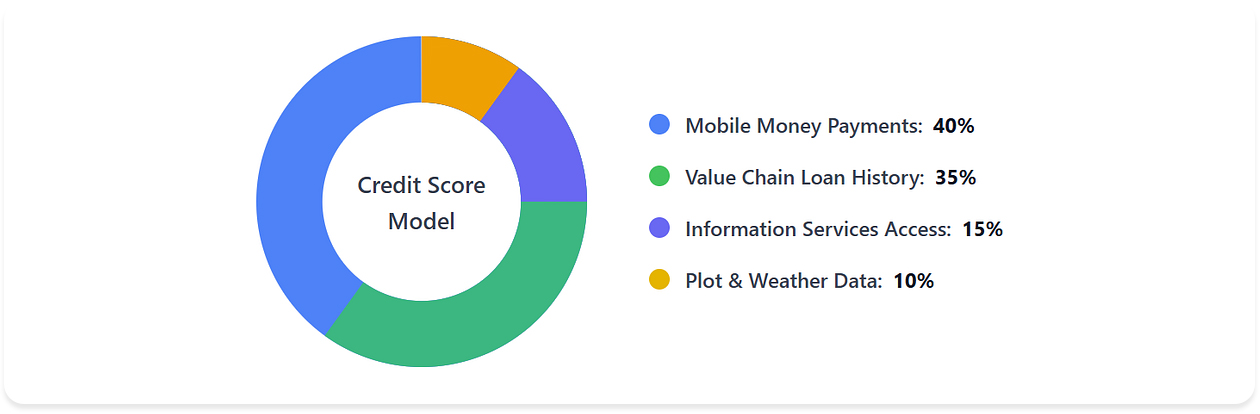
The true power lies not in any single data point, but in a layered, weighted approach that reflects their different strengths. Based on this analysis, I recommend the following framework for a new alternative credit score:
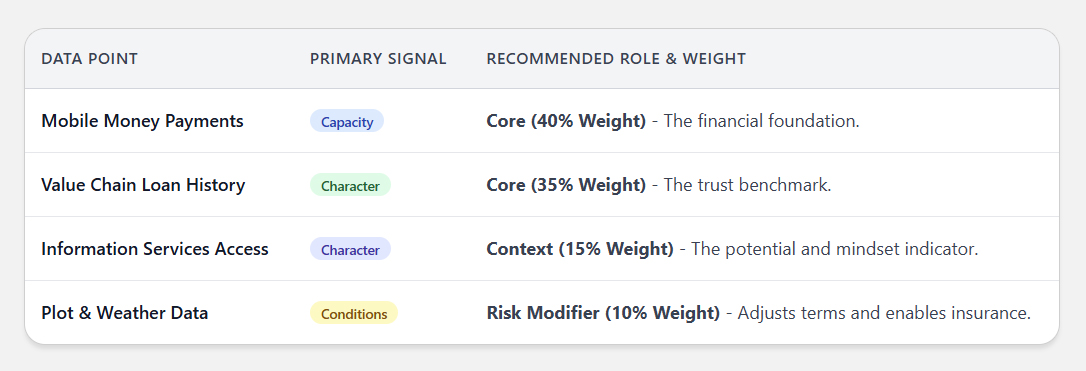
This model prioritises concrete financial and behavioural history (Capacity and Character) while using softer and environmental data (Character and Conditions) to refine the decision and manage portfolio-level risk.
Final Thoughts: Building a Bridge to Financial Inclusion
This exercise underscores a vital lesson for the future of agricultural finance: the path to inclusion is paved with data, but not all data is created equal. The most reliable signals come from a farmer’s financial and commercial actions (repayments and sales), not just their behaviours or environmental conditions.
For an MFI, the opportunity is clear. By partnering with digital platforms like DigiAgri, we can move beyond the dead end of collateral-based lending. We can build sophisticated scoring models that recognise the very real financial identities of smallholders, identities built on their proven trustworthiness and transactional history within their value chains.
The answer to “To Lend or Not To Lend?” is no longer a guessing game. It’s a data-driven decision.
By Raqibatu Zukaneni
Analyst (Product Development, Operations and Technology) at Accion
Digital Frontiers Institute Alum
(Also shared on Digital Frontiers on 20 March 2026)